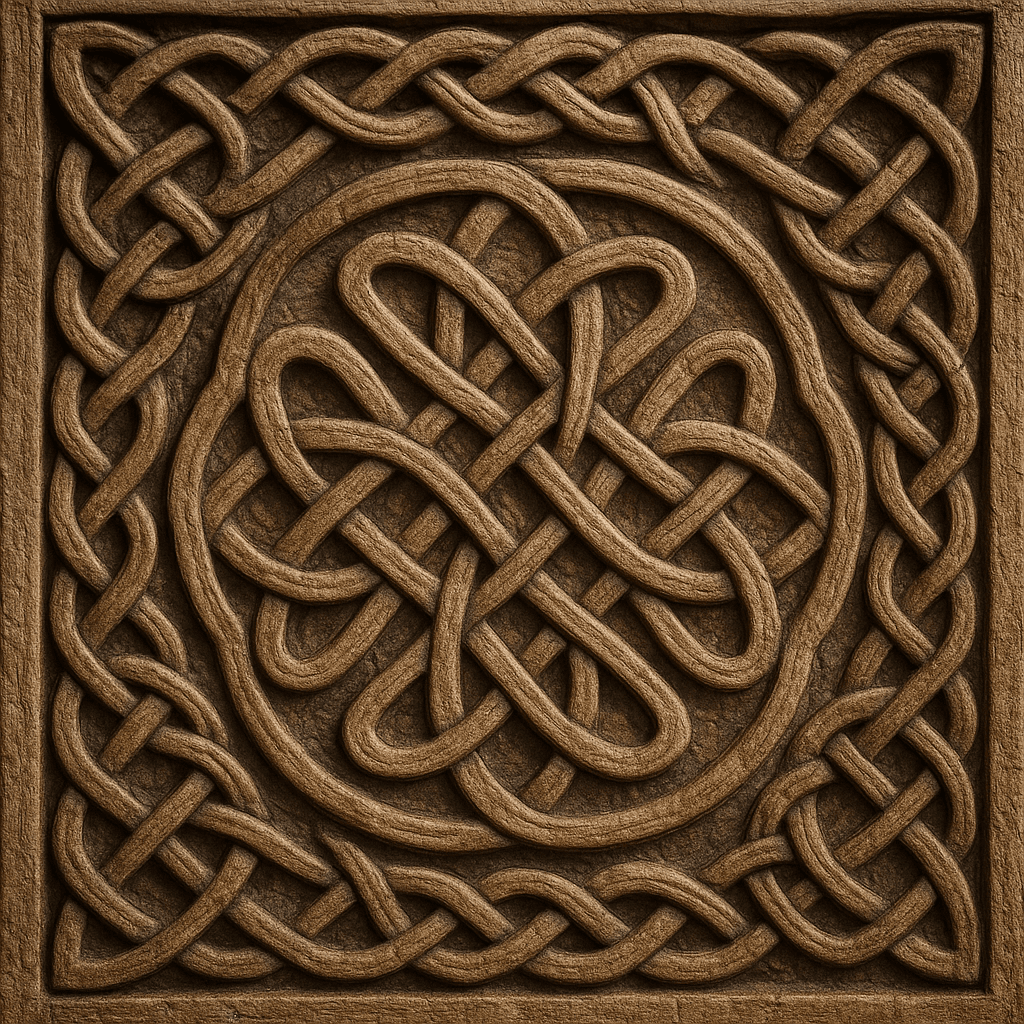
How do you carve a Celtic knot pattern in wood for beginners?
Getting Started with Celtic Knot Carving
Celtic knot carving techniques begin with understanding the fundamental principle of creating continuous interlace patterns with interwoven strands in relief on wood. Start by selecting soft wood like basswood in one-inch thickness, which forgives mistakes and holds detail well. Transfer your design using carbon paper and a simple grid system. Draw the design first by constructing a square or five-dot grid with at least three rows for a proper band. Sketch diagonal parallel lines for rope strands, alternating directions per cell, and loop open ends to connect at edges. Use templates from sources like the Trinity Celtic knot for your first attempts.
Outlining and Interlace Carving Process
The outlining process requires precision and patience. Score lines with a knife or small gouge measuring 3mm at the flattest point. Make stop cuts around the outer knot shape using a wide-sweep rounded gouge that matches the curve to avoid damaging your design. Angle cuts toward the pattern to pop out chips cleanly. The interlace carving stage demands careful attention to the over-under relationships that define Celtic knotwork. Use a knife for sharp points, then switch to a flat chisel or flat gouge to lower under ropes beneath crossings. Repeat matching gouges for curves and remove background material with slightly curved flat gouges or bent ones for tight spots. Stab cut to set uniform depth, working from back to front against the grain.
Finishing Techniques and Safety
Finishing touches bring your carved Celtic knot to life through depth and contrast. Add visual depth to overlaps with layered brown wash applied with a dry brush in multiple thin coats. This technique enhances the three-dimensional appearance of your interlace pattern. Practice on scrap wood first, as not all designs you find online suit wood carving applications. Redraw patterns to work with your wood grain rather than against it. Safety considerations include wearing protective glasses and securing your wood firmly on a hard surface. The over-under alternations and uniform band widths characteristic of authentic Celtic knot carving techniques emerge through careful attention to these foundational steps.
Basic Celtic Carving Methods

The Celtic Spirit: Daily Meditations for the Turning Year – Ancient Druid Wisdom and Sacred Practices for Reawakening Your Soul's Power
View Product →Basic Celtic carving methods center on relief carving principles that create the illusion of woven strands floating above the wood surface. The core approach involves outlining with small gouges, making stop cuts around exteriors, and lowering under-strands to achieve a convincing three-dimensional effect. Your knife becomes essential for creating sharp points where strands converge, while flat chisels handle the plane surfaces that form the top faces of your rope-like bands. Curved gouges follow the natural bends and turns of your interlace pattern, and you must repeat cuts precisely to maintain consistency across your entire design.
Background removal requires strategic tool selection and technique. Use flat or bent gouges to clear material around your raised elements without interfering with the carved edges of your pattern. The bent gouges prove particularly valuable when working in tight spaces where straight tools would strike your finished work. For snowflake-style knots, you repeat simple units with three to six arms, either fretted or carved in low relief on wood approximately 5mm thick. These designs often work well carved on both sides, creating reversible decorative elements.
The traditional approach to Celtic knot carving techniques emphasizes patience and gradual material removal. Work in stages rather than attempting to achieve final depth in single passes. This methodical approach prevents tearout and maintains clean edges essential to convincing interlace patterns. Your gouges should match the curves of your design as closely as possible to avoid faceted surfaces that break the illusion of smooth, flowing strands. The over-under alternations that characterize authentic Celtic interlace require consistent depth relationships throughout your carving.
Visual coherence emerges through attention to band width consistency and proper depth relationships. Each strand maintains the same width throughout its journey around the pattern, and the depth differential between over and under elements remains constant. This consistency creates the mathematical precision that gives Celtic knotwork its mesmerizing quality. The relief carving approach allows you to work efficiently while maintaining the visual complexity that makes these patterns so compelling. Your finished piece should demonstrate clear reading of the interlace path, allowing the eye to follow each strand through its complete journey around the design.
Advanced Interlace Pattern Creation
Advanced interlace pattern creation builds upon grid systems that generate increasingly complex Celtic designs through mathematical principles. Square grids create crossing strands per cell, while five-dot grids build single strands alternately, providing different aesthetic outcomes and structural possibilities. You analyze the underlying cellular structure, such as a four by three cell arrangement, to determine how patterns will function as panels or border elements. Break grids strategically to create proper knots, ensuring no common factors exist in cell ratios to maintain single-band flow throughout your design.

Pattern development starts with center lines or ribbon paths, then adds over-under relationships by alternating at crossings from a chosen starting point. This systematic approach ensures mathematical accuracy in your interlace relationships while maintaining the flowing quality essential to Celtic aesthetics. Incorporate spade-shaped turns at direction changes, internal breaks for deflections, and zoomorphic elements where appropriate to your design intent. Expand border patterns by adding walls and corners that maintain pattern integrity while accommodating rectangular or square formats.
Historical examples from illuminated manuscripts like the Book of Kells and the Lindisfarne Gospels provide authentic references for traditional weaving patterns and design principles. These sources demonstrate how medieval artisans solved complex pattern problems and maintained visual harmony across large compositions. Study these examples to understand how pattern density, strand width, and crossing frequency contribute to overall visual impact. The mathematical precision evident in these historical works reflects sophisticated understanding of geometric principles applied to decorative arts.
Complex pattern creation requires understanding how individual elements combine to form larger compositions. Multi-strand knots demand careful planning to ensure all strands complete their paths without creating impossible crossings or broken circuits. You develop pattern libraries by creating modular elements that combine in different ways, building complexity through repetition and variation rather than starting from scratch with each new design. The cellular approach to Celtic knot carving techniques allows you to scale patterns up or down while maintaining proper proportions and visual relationships. Your advanced patterns should demonstrate mastery of both technical execution and design principles that govern authentic Celtic interlace.
Traditional Woodworking Tool Selection
Traditional woodworking tool selection for Celtic knot carving requires specific gouges and chisels matched to the curves and angles inherent in interlace patterns. Small, flattest gouges measuring 3mm serve multiple functions including initial outlining, chip removal, and detail work in confined spaces. Curved gouges must match your design sweeps as closely as possible for clean stop cuts that follow the flowing lines of your pattern without creating faceted surfaces. Wide-sweep gouges prevent overcuts when removing background material, while their generous curves complement the organic feeling essential to Celtic aesthetics.
Knives and chisels handle different aspects of the carving process with specialized efficiency. Detail knives excel at creating sharp convergence points where multiple strands meet, while number 10 flat chisels provide the broad, clean surfaces needed for the top faces of under-ropes. The flat chisel width should match your strand width to achieve consistent results across your entire pattern. Bent gouges become indispensable when working in tight spaces where straight tools would interfere with adjacent carved elements.
Power tools like rotary cutters with appropriate bits speed certain aspects of Celtic knot carving techniques, particularly when creating repetitive elements like braided borders. Safety equipment including protective glasses becomes essential when using power tools, and you must secure your workpiece firmly on a stable surface. However, hand tools provide superior control for the precise over-under relationships that define quality Celtic interlace. The tactile feedback from hand tools allows you to feel when you approach final depth and avoid overcutting delicate intersections.
Tool maintenance directly impacts your carving quality and working efficiency. Sharp edges slice wood fibers cleanly, reducing tearout and eliminating the fuzzy edges that compromise crisp interlace definition. Your gouge collection should include tools specifically dedicated to Celtic work rather than sharing them with rougher carving projects that might damage the refined edges needed for detailed interlace. Matching tool curves to pattern requirements eliminates the need for excessive sanding or surface refinement after carving. The investment in proper tools pays dividends in both working pleasure and final results quality. Quality tools properly maintained will serve you through decades of Celtic carving projects while inferior tools frustrate your efforts and compromise your finished work.
Celtic-Inspired Altar Tables History
Celtic-inspired altar tables represent a fascinating intersection of ancient artistic traditions and modern spiritual practice, with roots extending back to the golden age of Celtic interlace between 600 and 900 CE. During this period, Irish, Scottish, and Welsh artisans developed the sophisticated interlace patterns we associate with Celtic art today, adorning high crosses, illuminated manuscripts, and stone monuments throughout Ireland, Scotland, Wales, and the monastery island of Iona. While few wooden artifacts survive from this era, historical evidence suggests that large wooden doors, church furnishings, and utilitarian items including altar tables featured the same intricate carved patterns found on surviving stone and metal works.

Sacred Earth, Sacred Soul: Celtic Wisdom for Reawakening to What Our Souls Know and Healing the World
View Product →The integration of Celtic interlace into religious and ceremonial contexts reflects the complex cultural transitions occurring during the early medieval period. Insular Celtic peoples adapted these geometric patterns after the decline of purely pagan traditions, incorporating them into Christian religious art while maintaining connections to pre-Christian symbolic meanings. The patterns filled decorative panels and border areas on standing stones and architectural elements, suggesting similar applications on wooden liturgical furniture including altar tables where the connected knot bands would create sacred boundaries around ritual spaces.
Archaeological evidence from sites like Scandinavian stave churches provides insight into how Celtic woodworkers might have decorated large wooden furniture pieces, though the perishable nature of wood means few examples survive from the medieval period. The sophisticated joinery and decorative carving techniques evident in surviving wooden artifacts from related traditions suggest that Celtic altar tables featured complex interlace patterns carved in relief, creating tactile and visual experiences that enhanced their ceremonial function. These pieces would have served both practical and symbolic purposes within sacred spaces.
The modern revival of Celtic spiritual practices has renewed interest in authentic decorative techniques for contemporary altar tables and ritual furniture. Celtic knot carving techniques adapted for modern use honor historical precedents while serving present-day spiritual communities seeking connections to ancestral traditions. The mathematical precision and flowing organic quality of traditional Celtic patterns create meditative focus during both the carving process and subsequent ritual use. Contemporary artisans studying historical examples from sources like the Book of Kells develop pattern libraries suitable for adaptation to three-dimensional wooden surfaces, ensuring continuity between ancient artistic achievements and modern spiritual expression. This revival represents more than mere decoration, embodying the enduring power of Celtic artistic vision to create sacred space through skillful craftsmanship and meaningful symbolism.
What sacred symbols will you bring to life through mastering these ancient Celtic knot carving techniques, and how will your carved creations connect you to the spiritual wisdom of our ancestors?
Related Items:

Lilly Dupres
Owner & AuthorLilly Dupres, a lifelong practitioner of paganism, established Define Pagan to offer a clear definition of paganism and challenge misconceptions surrounding modern pagan lifestyles.