Do You Need Charcoal to Burn Incense for Spellwork?
You want to know if are charcoal-free incense sticks worth buying for witchcraft is a question worth your time, and the short answer is yes, as long as you know what you’re paying for. You are not choosing between magic and no magic. You are choosing a format. The format affects your scent, your smoke, and how much control you have during a rite. For most witches, the stick format earns its place on the altar when the ingredients are clear and the burn is steady.
What Makes Incense “Charcoal-Free” in the First Place

Natural Incense Sticks Variety Pack - (5 Variants) Charcoal Free Inscents-Sticks, Made from Upcycled Flowers | Sacred Insence-Sticks from All Cultures (Inciensos Aromaticos)
View ProductCharcoal-free incense swaps out charcoal powder for botanical material that burns on its own. Think wood powder, bark, dried herb, or flower powder. A binder, usually a plant gum, holds everything together in stick form. Resins, essential oils, or fragrance oils give the scent. This mix burns steadier than loose herbs dropped on a charcoal disk. You light the tip, blow out the flame, and set the stick in a holder. No extra equipment needed.
That simplicity is the whole appeal. Loose incense on charcoal requires a brazier, a sand bed, tongs, and patience. A stick skips all of that.
Why the Stick Format Matters for Ritual Control
Here is where charcoal-free incense sticks earn their keep. A stick gives you a fixed, predictable burn time. You know roughly how long it will last before you light it. That matters when you are cleansing a room, opening a ritual, sending up a prayer, or sitting for a short meditation. You do not want to babysit a charcoal disk while you are trying to focus on the work.
For small spaces, this convenience is not a small thing. Not everyone has room for a brazier setup. A stick in a secure holder solves that problem without asking you to compromise the practice.
Charcoal-Free Does Not Mean Risk-Free
This is the part people skip, and it matters. Charcoal-free does not mean smoke-free. It does not mean chemical-free. It does not mean automatically safe to burn anywhere, anytime. Burning incense releases fine particles and combustion byproducts into the air. In a room with poor airflow, that buildup adds up fast.

RAAHI Floral Incense Sticks, 120 Sticks with Holder, Handcrafted & Charcoal-Free, Floral Aroma, 45–60 Min Burn, for Home Fragrance, Pleasant Ambiance, Meditation & Yoga
View ProductA few rules keep this manageable:
- Pick shorter-burning sticks over long ones.
- Open a window or crack a door for airflow.
- Keep the smoke away from your face and eyes.
- Skip the incense entirely if someone nearby has asthma or a strong sensitivity to fragrance.
Natural ingredients still make smoke. Cedar, rosemary, and sandalwood all burn down to particles in the air, just like anything else that burns.
Reading Labels Before You Buy Charcoal-Free Incense Sticks
The strongest sign of quality is a label that tells you what is actually inside. Look for named woods, herbs, resins, oils, or binders. If the label just says “fragrance” and stops there, that is a red flag, not a selling point.
Before lighting a single stick, give it a sniff. If it smells sharply synthetic right out of the package, skip it. Once lit, watch for excessive black smoke or a residue that feels sticky or overpowering. Good charcoal-free incense burns at a moderate, even pace and keeps a scent you can still identify as plant or resin, not just “nice smell.”
Matching Scent to Ritual Purpose, Not Magical Guarantee
Frankincense, cedar, rosemary, rose, sandalwood, mugwort. Each one carries cultural weight and personal meaning built up over time. None of them cast a spell by sitting in a holder. The scent supports your intention. It does not replace it.
Pick a scent that fits what you are doing and does not drown out the rest of the working. If you are speaking a prayer aloud, doing divination, or setting out an offering, a lighter scent lets those actions stay front and center instead of competing with a heavy cloud of smoke.
When Loose Incense Still Beats the Stick
Charcoal-free incense sticks are not a universal replacement. Loose incense on charcoal gives you more control over the blend itself and reaches a higher heat, which matters for raw resins like frankincense or myrrh. If a rite specifically calls for burning raw resin or a traditional loose mixture, do not swap in a stick just because it is easier. Save the stick format for routine cleansing, daily devotional work, and travel, where convenience outweighs precision.
The Mistake Most Buyers Make
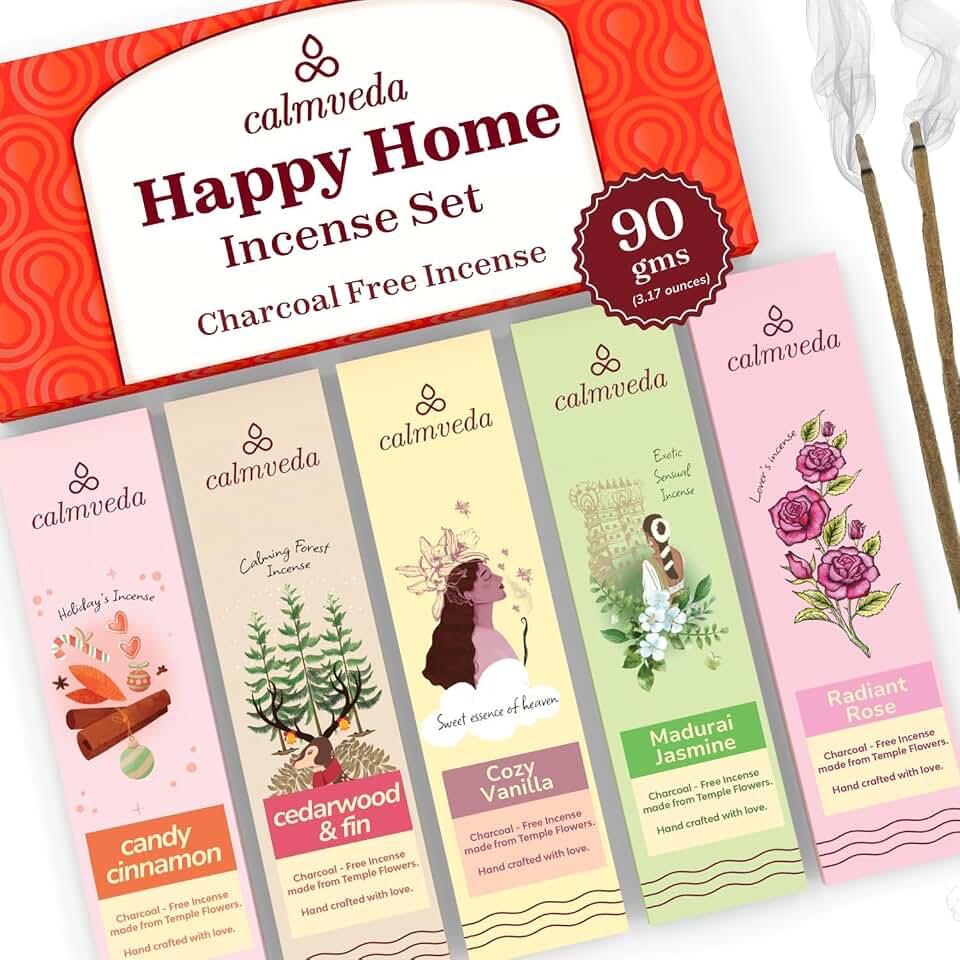
Happy Home Incense Sticks Multipack- (5 Variants) Charcoal Free, Made from Upcycled Flowers | Insense Cozy Warm Sticks Like Vanilla Cake, Balsam Cedar, Rose & Cinnamon | Perfect Incense Gift Set
View ProductDo not trust the word “natural” printed on a package without checking further. Read the actual ingredient list. Buy one stick before committing to a full box. Watch how the ash falls as it burns, since clean-burning incense tends to hold its shape in a tidy curl rather than crumbling or flaking.
Always set the stick in a stable, heatproof holder. Keep it away from cloth, paper, and anything else that catches fire easily. Put it out fully once your working ends, every time, no exceptions.
Making the Decision for Your Own Practice
Buy charcoal-free incense when you want convenience, moderate smoke, and ingredients you can actually name. Start small. Pick one or two scents that match your regular practice rather than buying a dozen scents you might never use. Burn them with a window open, and pay attention to how each one affects your focus and the mood of your space.
You now know what separates a well-made stick from a poorly made one, and you know where the format falls short. That knowledge is what makes charcoal-free incense worth buying in the first place, not the label alone. If you are ready to find sticks with ingredients you can trust, explore the incense and ritual tools in our pagan shop.

Lilly Dupres
Owner & AuthorLilly Dupres, a lifelong practitioner of paganism, established Define Pagan to offer a clear definition of paganism and challenge misconceptions surrounding modern pagan lifestyles.