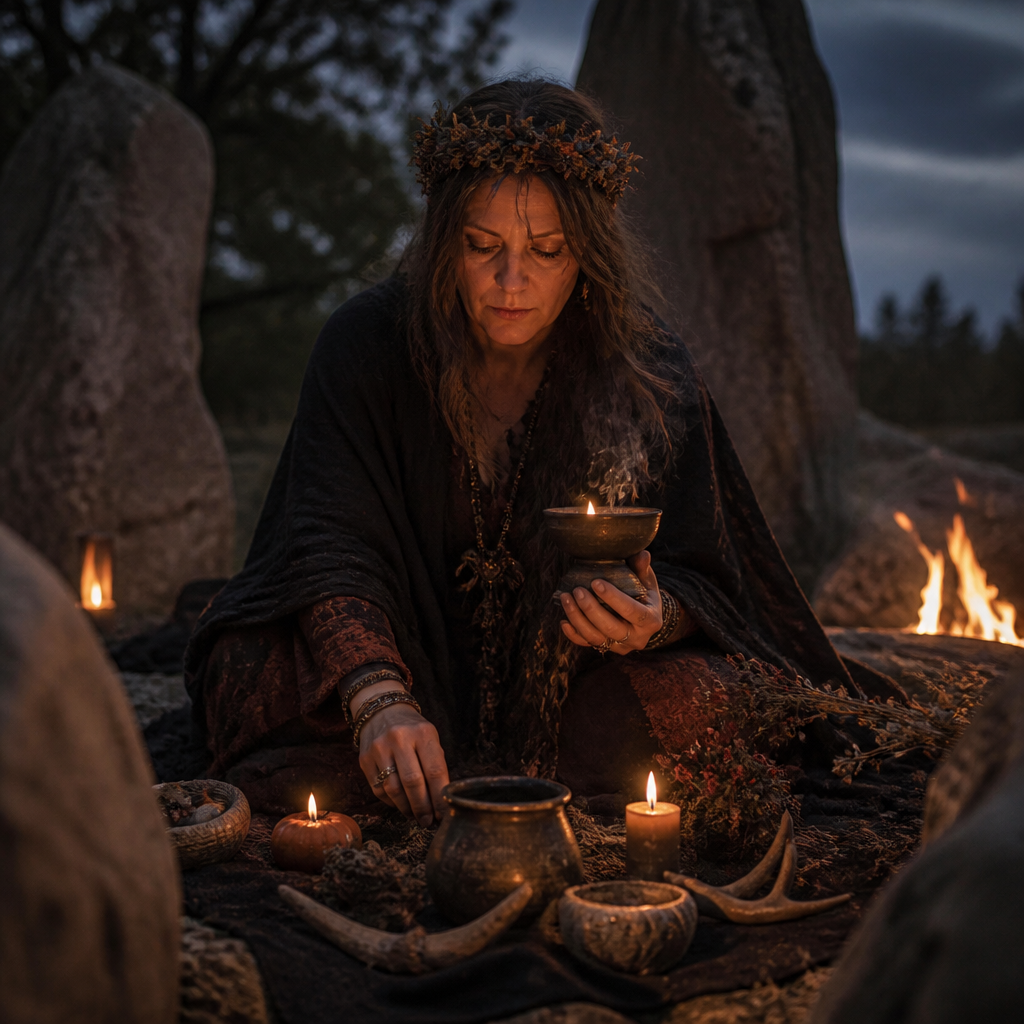
Should I Wear a Costume or Ritual Dress for Samhain This Year?
If you’re asking this question, you’re already thinking past Halloween decoration and into real practice. Good. The answer depends on what you’re doing on October 31st, not on what looks impressive in a photo.
Why Witch Costume vs. Ritual Dress Comes Down to Function

A costume and a ritual garment solve different problems. A costume tells people something about you in a few seconds. The pointed hat, the striped tights, the plastic broom all say “witch” instantly. That’s the job it’s built for.
Ritual dress has a harder job. It needs to let you kneel at an altar. It needs to let you carry a candle without the sleeve catching fire. It needs to survive an hour of standing, sitting, and moving around a fire pit without falling apart or distracting you from the work.
This is the real difference between witch costume vs. ritual dress choices. One is built for a glance. The other is built for use.
What Serious Practitioners Actually Wear for Samhain Rituals
Most experienced practitioners choose simple, breathable fabric. Cotton, linen, and wool show up again and again because they move with your body and don’t melt near open flame. Synthetic costume robes often do melt, or at least warp, if they get close to a candle.
Black is common in modern witchcraft, but it’s not a rule. White, red, green, brown, and undyed cloth each carry meaning in different traditions. Choose based on what the rite calls for, not on what looks the most dramatic.
Fit matters as much as fabric. A hem that drags on the ground outdoors is a tripping hazard around a fire. Loose sleeves near candles are a real fire risk, not a theoretical one. Secure fastenings matter more than decorative ones.
The History Behind Samhain Disguise and Why It’s Not the Same as a Costume
Samhain has old ties to disguising, masking, and mumming, especially in Ireland and Scotland. People covered their faces or changed their appearance for social, protective, or festive reasons. Some of it had supernatural meaning tied to the belief that the veil between worlds was thin on this night.
This is not the same thing as a commercial witch costume. The old practices were about concealment and transformation, not about signaling “witch” to onlookers. Modern pagans often adapt this symbolism through masks, veils, animal imagery, or ancestor colors. The spirit behind the practice matters more than the specific object.
Choosing Between Witch Costume and Ritual Dress Based on the Work
The right choice depends entirely on what you’re doing that night.
A public Samhain celebration might call for visible, seasonal clothing. Nobody is harmed if your outfit draws attention there.
A private ancestor rite calls for something quieter. A plain dark robe, a shawl, or ordinary clothes set aside only for ritual use work better than anything flashy.

A trance or devotional practice might benefit from a hood or veil. This only works if it doesn’t block your vision or make breathing hard. Comfort and safety come before symbolism every time.
No garment gives you authority. No costume replaces preparation. The clothing supports the work. It doesn’t do the work for you.
Material, Fit, and Safety Checks Before You Buy
Check the fabric before you buy anything for ritual use.
Look at the stitching. Loose threads unravel fast with regular wear.
Check the closures. Buttons and ties should hold under movement, not just for a photo.
Avoid loose sleeves near any open flame.
Avoid long hems if you’re working outdoors.
Avoid fragile trim and decorative plastic. These pieces often carry fire risk and rarely survive more than one season.
A well-made garment in cotton, linen, or wool outlasts a novelty robe by years. It also stays useful long after October 31st ends.
Building a Ritual Garment Without Spending a Lot
You don’t need an expensive or elaborate outfit to build real ritual clothing. Many practitioners take a plain skirt, tunic, cloak, shawl, or work shirt and set it aside only for magical use.
Here’s how that works in practice.

Renaissance Hooded Cloak Cotton Cloak Halloween Medieval Costume Cape Women Men
View ProductWash the garment and set its purpose clearly in your mind.
Wear it only for ritual, never for errands or regular days.
Store it somewhere intentional, not thrown in with daily laundry.
Over time, the repeated use builds the association. The garment starts to feel like part of the ritual because you’ve made it part of the ritual, not because of any special stitching or decoration.
Masks, Hoods, and Symbolic Additions Worth Considering
Masks and hoods change how you show up in liminal work, meaning the in-between space ritual tries to create. They can support that shift, but they also cut down your awareness of what’s around you. Only use them in a space you control and trust.
If you want to add symbolism, keep it simple. A cord, a brooch, a small herb pouch, or an ancestral textile adds meaning without adding risk. Piling on decorative objects usually gets in the way more than it helps.
Wearing What Supports the Work on October 31st
The real question behind witch costume vs. ritual dress is what you need the clothing to do. If the goal is play, public celebration, or disguise, a costume fits. If the goal is serious practice, you need clothing that helps build the container for that work and keeps you safe while you do it.
A dedicated ritual garment solves the exact problems this article raises: safety near flame, freedom of movement, and a consistent setting for serious practice. It gives you something a costume never can, which is clothing built for the work itself rather than the look of it. Explore ritual-ready pieces built for real practice at the Define Pagan shop.

Lilly Dupres
Owner & AuthorLilly Dupres, a lifelong practitioner of paganism, established Define Pagan to offer a clear definition of paganism and challenge misconceptions surrounding modern pagan lifestyles.